
What does OEKO-TEX® STANDARD mean?
Through independent certification, the STANDARD 100 confirms that your textiles and accessories have been tested for risks associated with harmful substances. Hohenstein has been supporting this commitment for decades with expertise, precision and experience. This allows you to build trust, strengthen your brand and ensure quality that inspires confidence. The OEKO-TEX® STANDARD 100 makes tested safety visible and tangible.
In addition to the basic certification of textile products, the OEKO-TEX® STANDARD 100 also offers the option of certifying footwear, textiles made from recycled materials, and products with specific requirements, such as personal protective equipment (PPE) and special articles.
The following additional OEKO-TEX® STANDARD 100 certification options are currently available:
STANDARD 100 + STeP = MADE IN GREEN
Together with the OEKO-TEX® STeP B2B certification, which assesses responsible production conditions in the textile and leather industries and systematically takes environmental and social aspects into account, the OEKO-TEX® STANDARD 100 forms the basis for the award of the OEKO-TEX® MADE IN GREEN label, which identifies products that have been tested for harmful substances and have also been manufactured under traceable, sustainable conditions. A unique, item-specific product ID provides additional transparency for products bearing the MADE IN GREEN label and enables the supply chain to be traced.
All details about the MADE IN GREEN Label
OEKO-TEX® – a strong community committed to greater sustainability
OEKO-TEX® brings together an international network of certification bodies (testing and research institutes) that have been developing common standards for textile testing for decades. First introduced to the public in the early 1990s, the OEKO-TEX® system continues to grow. New labels and services demonstrate how flexibly OEKO-TEX® responds to changing market demands.
What are the benefits of the OEKO-TEX® STANDARD 100?
- Legal compliance of your products in all major consumer markets
- The ideal tool for credibly marketing your textiles
- Clear, independent proof of product safety, verified for harmful substances
- Simplified supplier relationships through standardised, globally applicable criteria
- Efficient quality assurance without the need for in-house resources
How do you apply for OEKO-TEX® STANDARD 100 certification?
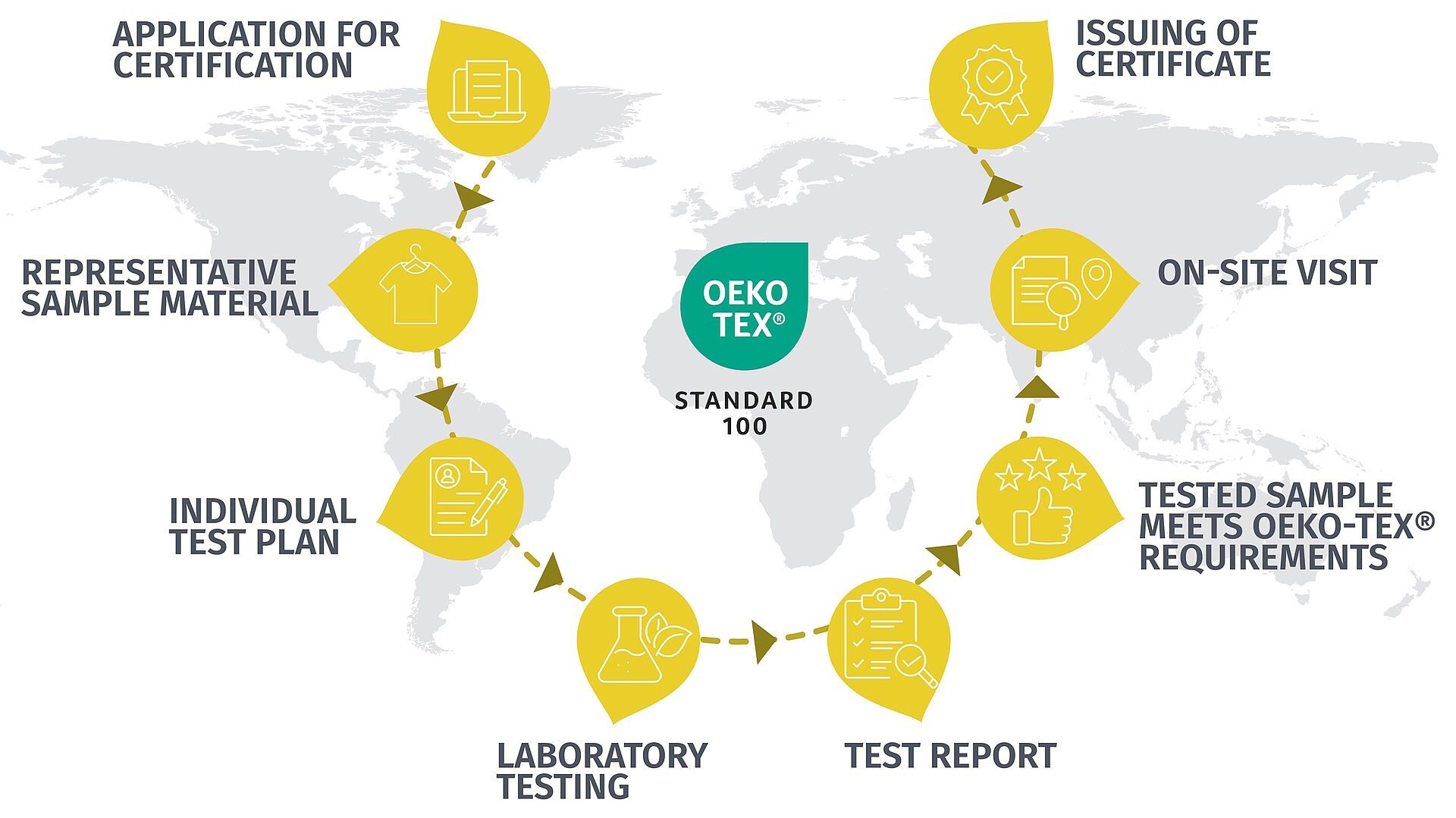
The OEKO-TEX® STANDARD 100 certification process follows clearly defined steps and ensures transparency from the outset. A structured application form is available, which systematically records all relevant details regarding the product, materials and production.
Checklists for the application and selection of test samples
What are your next steps?
Downloads
Please always use the latest version of the required forms for your application, which you can download below. Our application checklist contains useful information to help ensure your application goes smoothly.
Application forms to be submitted – STANDARD 100
Application forms to be submitted – Supplements Special Articles & PPE
Supporting documents for your information
Frequently asked questions about the OEKO-TEX® STANDARD 100
Basic information
The OEKO-TEX® STANDARD 100 is an internationally recognised, independent testing and certification system for textile raw materials, semi-finished and finished products at all stages of processing, as well as their accessories. It confirms that products have been tested for harmful substances in accordance with scientific criteria and supports companies throughout the textile supply chain (brands, manufacturers, retailers) in demonstrating product safety in terms of human health and the environment in a credible and transparent manner.
The OEKO-TEX® STANDARD 100 offers a high level of product safety thanks to:
- Laboratory tests carried out by independent, accredited bodies
- Test criteria and limit values for harmful substances updated annually
- Testing of all components of an article for harmful substances
- The testing requirements depend on the intended use of an article and the sensitivity of the user
(see also: Explanation of the OEKO-TEX® product classes)
Product inspections
The reliability of the OEKO-TEX® STANDARD 100 label is further ensured by product inspections, which OEKO-TEX® carries out on at least 25% of all certificates issued annually. To this end, products bearing the OEKO-TEX® label available on the market, as well as samples taken during audits and unannounced visits to OEKO-TEX® certified companies, are subjected to laboratory testing again even after the certificate has been issued, and checked for compliance with the required criteria.
Product certification in accordance with the OEKO-TEX® STANDARD 100 is carried out exclusively by authorised OEKO-TEX® member institutes.
Hohenstein is a co-founder of OEKO-TEX®, established in 1992, and offers companies across the entire value chain all certifications and product labels within the OEKO-TEX® portfolio. This includes practical solutions for the implementation of:
- Product stewardship
(OEKO-TEX® solutions: STANDARD 100, ORGANIC COTTON, LEATHER STANDARD, MADE IN GREEN, ECO PASSPORT) - Sustainable manufacturing processes
(OEKO-TEX® solutions: STeP, MADE IN GREEN) - Social working conditions
(OEKO-TEX® solutions: STeP, MADE IN GREEN) - Transparent supply chains
(OEKO-TEX® solutions: MADE IN GREEN, myOEKO-TEX®) - Corporate due diligence
(OEKO-TEX® solution: RESPONSIBLE BUSINESS)
Even before OEKO-TEX®, there was a dedicated testing system for harmful substances in textiles known as the “Hohenstein Oeko Check”, the concept of which was incorporated into the OEKO-TEX® STANDARD 100 when it was first introduced in 1992. Hohenstein continues to play a key role in the development of OEKO-TEX® requirements and criteria and, with the highest number of OEKO-TEX® certificates and labels issued, is one of the most important OEKO-TEX® testing laboratories worldwide.
A STANDARD 100 certificate is valid for 12 months and can be renewed annually. We recommend starting the renewal process up to three months before expiry to ensure continuous product safety without any interruption to the certificate status and a smooth process throughout the modular OEKO-TEX® system. Many downstream certifications depend on pre-certified components from suppliers.
The OEKO-TEX® STANDARD 100 is designed as a modular system. This means that product certification is possible at every stage of the textile value chain. Raw materials already certified to OEKO-TEX® STANDARD 100 are recognised at subsequent production stages, thereby reducing the testing effort and costs for such items.
Your benefit: Testing costs are spread across the individual stages of the textile chain and are not as high for the finished product if all components have already been successfully tested to STANDARD 100.
The OEKO-TEX® Buying Guide supports you in your targeted search for suitable suppliers – a free, global online directory of OEKO-TEX® certified products, manufacturers and brands.
The OEKO-TEX® STANDARD 100 list of harmful substances defines a comprehensive, globally applicable framework for analytical laboratory testing to assess textile products (including non-textile accessory materials).
The applicable testing criteria are updated annually and take into account the latest scientific findings, regulatory developments and new requirements from the market and industry.
In many cases, the OEKO-TEX® STANDARD 100 limit values for harmful substances are significantly lower than the statutory minimum requirements, underlining the standard’s international standing and role as a benchmark.
The test criteria and limit values applicable to individual chemicals are published in the OEKO-TEX® Restricted Substances List and are freely accessible.
The laboratory tests carried out in accordance with OEKO-TEX® STANDARD 100 cover, amongst other things:
- substances that are prohibited or restricted by law
- known chemicals of health concern
- other substances that pose a potential health risk
The binding test parameters and limit values for textile substance testing in accordance with the OEKO-TEX® STANDARD 100 are published in the official list of substances, which includes a table of limit values.
You can find the OEKO-TEX® RSL on our website under the menu item OEKO-TEX® / Applications & Standards.
The criteria and limit values for substance testing under the OEKO-TEX® STANDARD 100 depend on the type and materials of the product in question, but above all on its intended use.
The following applies: the more direct the skin contact and the more sensitive the skin, the stricter the requirements for the product.
Accordingly, the OEKO-TEX® STANDARD 100 distinguishes between four product classes:
- Product Class I:
Textiles and materials for babies and young children up to three years of age: underwear, rompers, bed linen, bedding, etc. - Product Class II:
Textiles and materials whose surface comes into direct contact with the skin: underwear, bed linen, towels, shirts, blouses, socks, etc. - Product Class III:
Textiles and materials whose surface comes into direct contact with the skin only to a limited extent: jackets, coats, outdoor textiles, etc. - Product Class IV:
Furnishing materials for decorative purposes: table linen, curtains, upholstery fabrics, etc.
The OEKO-TEX® STANDARD 100 certificate and label are only awarded if all components of an item meet the required criteria without exception. In the case of finished garments, for example, this includes the outer fabric, all sewing threads, the lining, as well as dyes, finishes and prints, and (non-textile) accessories such as buttons, rivets or zips. However, this basic requirement applies to textile products at all stages of processing.
Textile products, on the other hand, may not be labelled with the OEKO-TEX® STANDARD 100 if only individual components (e.g. zips or the lining of jackets, which typically consist of many other components) meet the OEKO-TEX® requirements.
Industry & Retailers / Traders
- With OEKO-TEX® STANDARD 100 certification, textile manufacturers, suppliers and producers demonstrate that their products comply with strict, internationally recognised limits on harmful substances, thereby opening up new sales opportunities in all major consumer markets through legally compliant products.
- Importers, (retail) traders and brands are able, on the basis of the OEKO-TEX® STANDARD 100 certificate, to quickly and reliably find suitable suppliers of products that are safe for human health and the environment, and to credibly demonstrate their product responsibility to consumers.
Procurement & Consumers
- The OEKO-TEX® STANDARD 100 label offers textile users valuable guidance to help them make responsible and informed decisions when purchasing textiles.
The certification process
To have their products tested for harmful substances and certified in accordance with the OEKO-TEX® STANDARD 100, companies must complete the relevant application form and send it to Hohenstein, together with representative test samples from their current production run.
We recommend that all interested parties contact our customer service team (Telephone: +49 7143 271-898, Email: customerservice@hohenstein.com) to clarify as many details as possible in advance and thus ensure a quick and smooth certification process.
Below you will find our checklists for the application process and suitable sample materials for laboratory testing:
The costs for OEKO-TEX® STANDARD 100 certification generally consist of an annual licence fee and the costs associated with laboratory testing of your product.
The costs for laboratory testing depend on the material and complexity (e.g. fibres, yarns, dyed or finished fabrics, ready-to-wear garments, accessories, etc.) of the product being tested for harmful substances, as well as the specific criteria applicable to its intended use.
For detailed information on the costs, we recommend that you contact our customer service team directly. We will provide you with a transparent quote based on your application.
Once we have received the application and sample materials, and all relevant queries have been fully resolved, the certification process usually takes up to four weeks, depending on the complexity of the test samples.
To ensure a seamless continuation of existing OEKO-TEX® STANDARD 100 certificates, we recommend that all companies submit their renewal application to us three months before the certificate’s expiry date.
Product certification in accordance with OEKO-TEX® STANDARD 100 follows a standardised, structured process and comprises the following steps:
- Submission of an application by the company, including the selection of representative product samples for laboratory testing
- Preparation of an individual test plan by Hohenstein
- Analytical laboratory testing of the samples provided from current production
- Preparation of a detailed test report containing the results of the laboratory tests (pass/fail)
- Legally binding declaration of conformity by the applicant, stating that the quality of the manufactured products corresponds to the tested samples for the duration of the certification
- On-site visit by Hohenstein to the company to verify the quality assurance measures guaranteed by the applicant regarding compliance with the OEKO-TEX® criteria
- Issuance of the OEKO-TEX® STANDARD 100 certificate, valid for one year
The product samples selected by the applicant for testing for harmful substances in our laboratories must be representative of the goods actually manufactured and sold. Furthermore, the test samples must come from the current production run.
Please note that, depending on the product to be tested, certain quantities of material are required and that the test samples must meet specific requirements regarding packaging and dispatch to Hohenstein.
Below you will find our checklist for the selection and dispatch of suitable sample materials for laboratory testing:
The number of samples depends on the product, material and pre-certification. In the case of finished products, it may be necessary to take them apart for testing. The requirements are set out in the test plan.
Below you will find our checklist for selecting and sending suitable sample materials for laboratory testing:
Different products that meet the requirements of the same OEKO-TEX® STANDARD 100 product class may be grouped together in the article group description on the certificate. It is not possible to mix articles belonging to different product classes on the same certificate.
No. Items with the same material composition, intended use and OEKO-TEX® product class can be grouped together. However, products from different product classes require separate certificates, as the testing requirements differ.
An on-site visit to the applicant company is mandatory for OEKO-TEX® STANDARD 100 certification. Our OEKO-TEX® auditors go through all the details of the certification process on site and, in particular, check whether the quality assurance system declared by the company is suitable for ensuring compliance with the required OEKO-TEX® criteria. Furthermore, during the site visit, companies have the opportunity to clarify any outstanding questions in a face-to-face meeting, for example regarding the correct product labelling and other promotional use of the OEKO-TEX® STANDARD 100 product label.
Working with the OEKO-TEX® STANDARD 100
You can check the validity of an OEKO-TEX® STANDARD 100 certificate or product label yourself at any time using the OEKO-TEX® Label Check. To do this, enter the full certificate number (without specifying the testing institute) into the search field.
The results will show the validity status of the certificate as well as a detailed description of the article group, i.e. an overview of which products are covered by the certificate number.
In the OEKO-TEX® Buying Guide – a free online directory where you can search for certified products, as well as companies and brands with an OEKO-TEX® certificate. Various filters are available to help you refine your search, such as the desired OEKO-TEX® certificate, the type of product or the region in which the companies are based. As a result, the OEKO-TEX® Buying Guide provides excellent support in selecting trustworthy partners and sourcing suitable raw materials or retail products.
Companies with a valid OEKO-TEX® STANDARD 100 certificate can generate and download the label templates they need in various designs and file formats free of charge. To do this, you must first log in to the myOEKO-TEX® customer portal and open the OEKO-TEX® Label Editor.
In the Label Editor, you must carry out the following steps:
- Select the desired OEKO-TEX® certification or the type of label (e.g. OEKO-TEX® STANDARD 100).
- Click on the relevant products or certificates displayed with the corresponding number or product ID.
- Select the desired design for the label or hangtag (e.g. colour vs. black and white, portrait or landscape format, with or without a QR code, etc.) that you wish to create.
- Specify the desired file format for the label template or hangtag (e.g. SVG and PNG for web applications, EPS or PDF for printed materials, etc.).
- Click on “Export” to generate and download the desired labels.
Good to know:
- If you do not yet have access to the myOEKO-TEX® customer portal or are having difficulty logging in, please contact our customer service team:
Pone: +49 7143 271-898
Email: customerservice@hohenstein.com - You can find detailed instructions on how the OEKO-TEX® Label Editor works and what options are available in a YouTube online tutorial.
There are clearly defined regulations and guidelines governing the use of the OEKO-TEX® labels for product labelling and promotional purposes at the point of sale, as well as in marketing materials. This ensures a consistent global appearance of the labels, which protects the value and integrity of the OEKO-TEX® brand and ensures clarity, credibility and consistency. The rules form an integral part of the respective OEKO-TEX® Standard and prevent the accidental or deliberate misuse of the OEKO-TEX® logos and labels, which are protected as trademarks.
The guidelines for product labelling and advertising using the labels are summarised clearly and comprehensively in the OEKO-TEX® Labelling Guide. The following principle applies in general:
- Where general statements or descriptions are made regarding any of the OEKO-TEX® certifications or product labels, the relevant product logo must always be used. In such cases, the context is always such that there is no direct reference to a specific product.
Examples:
Advertising materials, websites and corporate materials such as brochures, posters, newsletters, presentations, exhibition stands, and in corporate communications
- If, on the other hand, OEKO-TEX® certified products are advertised directly, the associated product label must be displayed; this must correspond to the certificate issued for the product. The link between the label shown and the advertised product must be clear and must correspond to the label attached to the actual item. Using the specific certificate number, product ID or a QR code on the label, the user is able to transparently track the type and scope of the OEKO-TEX® certification and verify the validity of the label.
Examples:
Products in online shops; physical products; catalogues through which products can be ordered directly
In many cases, no. Provided the materials and production conditions remain unchanged, the certificate can be extended efficiently. The modular system of the OEKO-TEX® STANDARD 100 reduces the effort and costs involved.
Manufacturers and suppliers
Yes, provided that the preliminary certificates (base certificates) are valid and their content is appropriate, components that have already been certified can be recognised in subsequent production stages for OEKO-TEX® STANDARD 100 certification. This modular principle allows the costs of certification to be spread across the individual processing stages, thereby reducing the scope of testing.
Please note: With the new regulations coming into force from 2026 for the OEKO-TEX® STANDARD 100, there will be changes to the acceptance of basic certificates and a corresponding transition period until June 2027.
Importers, wholesalers and traders
Products certified to the OEKO-TEX® STANDARD 100 may currently still be marketed and advertised using the relevant, valid label without retailers having to apply for their own certificate. However, if a retailer wishes to obtain or requires a separate OEKO-TEX® STANDARD 100 certificate with its own number, an application can be made.
Please note: With the new regulations coming into force from 2026 for the OEKO-TEX® STANDARD 100, there will be changes to the acceptance of basic certificates and a corresponding transition period until June 2027.
Retailers and brands
A retailer or brand does not need its own OEKO-TEX® STANDARD 100 certification. It is possible to market and advertise products using the relevant, valid label – for example, that of the supplier – provided this has been agreed with the supplier or confirmed by the supplier. No additional testing costs are incurred provided that a valid certificate already exists for the product being sold. A licence fee for a separate certificate is only required if a retailer or brand wishes to obtain or requires an independent OEKO-TEX® STANDARD 100 certificate with its own number.
Note
From 2027, there will be changes to supply chain certification. You can find more information on this in this year’s webinar on the new OEKO-TEX® regulations.
Register here for free & watch the webinar